

At first glance, the Geely Okavango and Jetta VS7 seem like cars from different worlds: one is a large “family man,” the other a more compact, stern-looking crossover. However, they share the same roots. Jetta is essentially a Chinese interpretation of Volkswagen, while Geely is often perceived as a “Chinese Volvo.” In both cases, behind the external differences lies a European engineering school and a proven set of components. That’s why the comparison suggests itself, especially since both models are easy to imagine as the only car in a family—just with opposite characters.
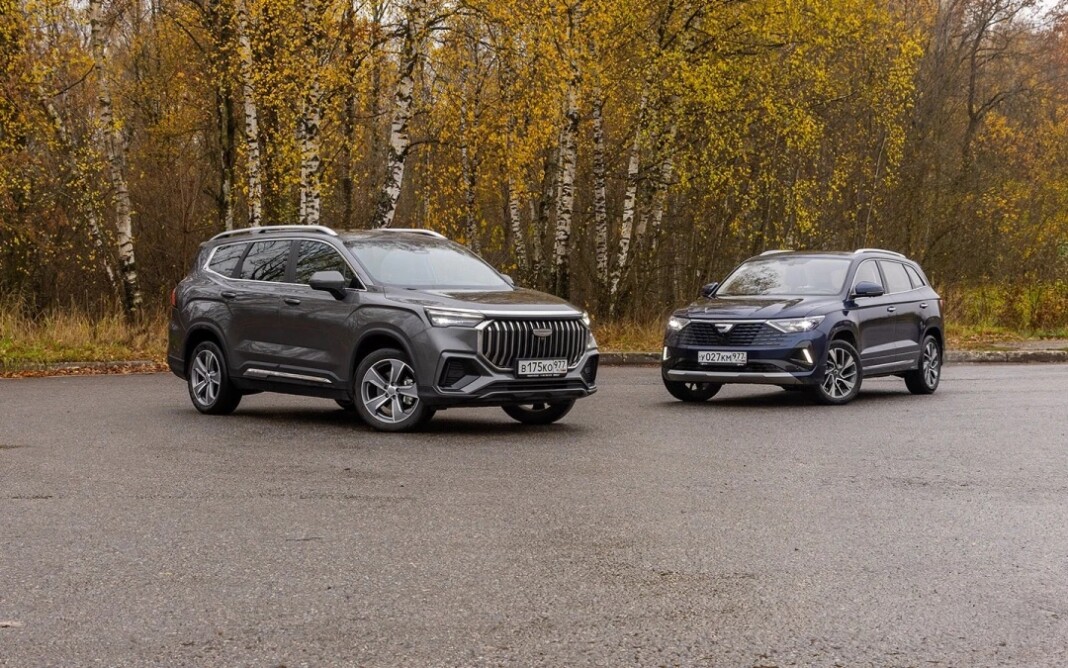
Formally, they are rivals only on paper. The VS7 in its usual configuration is designed for five people (although a seven-seat version is also found in its home market), whereas the Okavango offers seven seats from the outset. Hence the difference in perception: the Geely is noticeably larger and looks more “home-oriented” in purpose. In terms of dimensions, it wins across the board: 236 mm longer, 69 mm wider, and 146 mm taller, with a wheelbase 95 mm longer. This also affects practicality: even with the third row folded, the Okavango’s trunk holds 628 liters, while the VS7’s holds 548 liters.
That said, neither spoils you when it comes to cargo-area organization. The Jetta’s trunk is as simple as it gets: a light, an upper shelf, hard plastic, and a space-saver spare under the floor—no hooks or other conveniences. Geely hasn’t gone much further either: there’s lighting and a 12 V socket, but you’ll have to buy the cover, mat, and tie-down elements separately. Its spare wheel is hidden under the body; it’s awkward to access, but under the floor there’s a roomy compartment with a two-section organizer.
You shouldn’t count on off-road ability with either of them: there’s no all-wheel drive in any trim. But nuances matter. The Okavango is heavier (1,780 kg versus 1,425 kg for the VS7) and at the same time has less ground clearance—184 mm versus 210 mm. So on a broken dirt road and in ruts, the Geely will have a harder time.
The Okavango’s interior immediately makes it clear where most of the budget went: into volume and space. The trim is deliberately simple, in places hard, without any “atmosphere”—there isn’t even lighting in the sun visors. Visually, the interior is friendly, but rather gloomy and seemingly outdated. On the plus side, the ergonomics are straightforward, “old-school”: the mirrors are adjusted from the door, and the dual-zone climate is controlled by a separate row of buttons. The seating position is comfortable even without lumbar support, although you’d want a wider range of steering-wheel reach adjustment. There’s a wireless charging pad and a sufficient number of USB ports. One oddity is the non-latching gear-direction selector, which you have to “tug” twice, but you get used to it quickly. The armrest includes a cooled box, and on the lower tier of the center console there’s a 12 V socket. At the same time, the fashion for screens has brought its downsides: the seat heaters are switched on through the multimedia menu, and the climate control can sometimes behave unpredictably—at the same temperature it may blow either icy or hot air.
The Geely’s second row is one of its main arguments: three individual seats with separate fore-aft adjustment and a very large reserve of space. The instrument cluster and multimedia are nothing fancy, but Apple CarPlay is available—though only wired.
Inside, the Jetta VS7 looks brighter and more youthful, although in essence it remains just as functional. Two-tone trim, light inserts, and white stitching liven up the picture, but the simplicity of the materials hasn’t gone anywhere: the plastic is frankly hard, and narrow strips of “leatherette” only slightly save the impression. The instrument and multimedia screens are modest, and the glossy touch climate panel feels alien. There’s no lighting for the vanity mirrors—just like in the Geely. The smartphone connects via wired Apple CarPlay.
But in terms of control convenience, the VS7 is close to the classic “Volkswagen” benchmark: a logical center console, a familiar transmission selector with manual mode, and firm seats. In the second row there’s enough legroom, but the equipment is minimal: a simple vent, a folding armrest, and one USB port, with no rear-bench adjustments (photo: autonews.ru).
Technically, these crossovers seem to be from different leagues. The Jetta has a 1.4-liter gasoline turbo engine with 150 hp and 250 N·m, while the Okavango has a 2.0-liter turbo with 200 hp and 325 N·m. On paper the gap is large, but in reality it’s barely felt: the Geely accelerates to 100 km/h in 9.6 seconds, and the Jetta in 10.2 seconds.
