

On December 25, the 2026 Geely Galaxy A7 plug-in hybrid underwent a comprehensive Double TOP safety evaluation. Following the tests, the model became the first midsize PHEV in China to complete this “double” challenge, and it also turned out to be the only one in the industry to receive two documents at once: a safety performance challenge certificate and an intelligent safety challenge certificate. The manufacturer emphasizes that the A7 is built on Geely’s “safety genes” and seven key advantages, and that the test results should cement the car’s role as a new benchmark in the “100,000” price-level hybrid sedan segment.
Why there is so much attention around the A7
The Geely Galaxy brand, backed by Geely Automobile’s global safety system, is called the world’s fastest-growing “new energy” line: annual sales have reached 1 million vehicles. Against this backdrop, the Galaxy A7 is one of the flagship models and, as stated, fully inherits Geely’s approach to safety—something that was verified at the China Automotive Center test site.
Test logic: a focus on real road situations
The Double TOP program is built around scenarios a driver encounters not “on paper,” but in everyday use. The test is divided into two major blocks:
- passive safety (strength and preservation of living space under impacts and crushing);
- active safety (how electronic assistants perform in typical and complex road episodes).
Passive safety: two “difficult tasks” and the result
1) Static pressure on the front beam: a strength test “without acceleration”
The first test simulates common urban mishaps: low-speed contacts, “scrapes,” frontal touches, and crushing by an external force. Unlike a dynamic crash test, this makes it clearer how the structure holds a constant load and where the deformation limit lies.
In this exercise, the Geely Galaxy A7 relied on a mesh-shaped ultra-high-strength steel front anti-collision beam made using a roller press-forming method. A two-stage anti-collision structure is also cited, along with a 240 mm-long energy-absorbing zone. By design, this should:
- reduce damage to the front longitudinal members and engine-bay components in low- and medium-speed impacts;
- reduce the effect on the passenger compartment in more severe collisions.
As a result of the “devilish” static pressure test, the car handled the task.
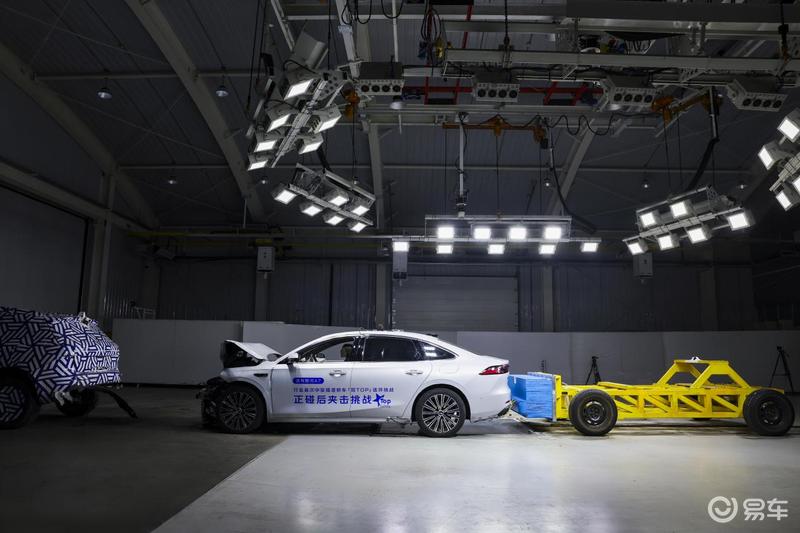
2) “Front-to-back attack”: first a frontal impact, then a more complex scenario
The second passive-safety block consists of two parts.
Frontal collision
This is a basic but telling scenario: it checks how the front body structure absorbs energy, how the restraint systems work, and how well the cabin is protected. After the impact, according to the test description, the Geely Galaxy A7 showed:
- the high-voltage system shut down normally;
- the hazard lights (double flash) activated correctly;
- the A-pillar did not suffer critical deformation;
- the door opened normally;
- the driver and front passenger airbags deployed as intended;
- the seat belts functioned correctly;
- the living space in the cabin was preserved.
The success is attributed to the body’s load-bearing structure: the share of high-strength steel exceeds 71%. Also mentioned is a clover force relief design that helps transfer loads during an impact, as well as a patented “clover force transfer channel” at the front that distributes energy and supports the integrity of the frame.
Rear impact after the frontal crash: a “double collision” under a tougher logic
The organizers proceeded from the fact that real accidents often happen in a “chain,” so they increased the difficulty. The scenario models a rear impact at 80 km/h, using a U.S. standard with 70% overlap (offset).
The stated results for the A7 are as follows:
- no fire occurred;
- no oil leaks were recorded;
- the fuel tank did not leak;
- the doors continued to open normally;
- passenger space remained sufficient, with no dangerous structural intrusion.
The manufacturer explains this by the architecture and a set of measures: an “oil-electricity-gas” isolation system, a physical safe distance of more than 198 mm, and an “oil-electric safety compartment” with six horizontals and four verticals. Also highlighted are three-level protection against temperature differentials in the lower section and S.H.I.E.L.D. battery protection that meets 36 safety standards—claimed to be significantly higher than national requirements.
Active safety: eight scenarios and assistant performance
As part of Double TOP, the electronic systems were also tested—not in one or two episodes, but in eight “high-frequency” situations: day and night, involving cars, pedestrians, and two-wheeled transport.
What situations the Galaxy A7 handled
- A child dummy suddenly runs out between two cars at 60 km/h: the system recognizes the small target and confidently stops the car at a safe distance.
- Several pedestrians cross the road at 80 km/h: correct identification of people of different heights and builds, braking without a collision.
- Emergency braking by the vehicle ahead at 90 km/h: adaptive cruise control and AEB recognize the danger; deceleration and stopping are smooth, without impact.
- A stationary vehicle in the lane with a 50% offset at 50 km/h: the system “locks onto” a complex static target and brakes to a stop.
- A stopped car ahead at a high speed of 120 km/h: AEB detects the obstacle and provides sufficient braking force while maintaining a safe interval.
- A nighttime scenario with a black stationary car ahead at 100 km/h: in low visibility, the target is recognized, braking is applied, and the car stops.
- At night, a two-wheeled vehicle crosses the trajectory at 45 km/h: the system quickly detects the object and helps avoid a collision.
- A complex situation at 130 km/h: the vehicle ahead “moves away,” revealing a stationary obstacle; the AES function (active emergency steering) detects the danger and performs a sensible avoidance maneuver with a stable trajectory.
How Geely says it was achieved
The key element is said to be the thousand miles vast driving assistance H3 solution—a full-featured intelligent driver-assistance system for mass-market sedans, focused on practicality and safety. It is emphasized that it can predict risks using AI models and plan the optimal maneuver in advance.
MAI and AES functions are also noted, which are said to be refined for scenarios where classic AEB can fail. In particular:
- AEB is supported at speeds up to 120 km/h;
- AES works up to 130 km/h;
- a total of 16 active safety functions are claimed, including MAI false-acceleration suppression.
Geely’s safety “foundation” and the A7’s place in the lineup
Geely continues to promote the thesis “safety first.” On December 12, the company officially unveiled the Geely Global Safety Center, which reportedly set five Guinness world records, and the “Global Safety 2.0” technical system was updated. Over 11 years, more than 250 billion yuan has been invested in R&D, five major proving grounds have been created, and 16 test bases have been established worldwide.
Industry achievements in certification are also listed separately, including:
- the industry’s first “six-dimensional” electrical safety certificate No. 001 for NEVs;
- the first electromagnetic radiation protection certificate No. 001 for NEVs;
- the first certificate for management processes of an automotive intelligent computing center;
- the first hybrid-system reliability certificate for NEVs.
Seven safety directions the Galaxy A7 relies on
- Driving safety: the Thor AI hybrid 2.0 system with an emphasis on a “German” handling gene; chassis tuning with participation from the Lotus team to reduce the risk of driver errors.
- Health and safety: cabin VOC control stricter than the national standard.
- New energy safety: S.H.I.E.L.D. battery protection.
- Passive safety: a high-strength frame and a multi-chamber passenger-compartment structure based on a “progressive” architecture.
- Active safety: the AEB + AES combination as a “leap” in assistant capabilities.
- Anti-theft safety: the Galaxy Flyme Auto intelligent cockpit with a remote camera and a “sentinel” mode after exiting the car.
- Digital safety: the Xingrui computing center and cloud protection for AI operating scenarios.
Conclusion: what the Double TOP certificate means for the buyer
Geely notes that during development the Galaxy A7 underwent tens of thousands of simulated checks, and that the model has already been selling for four consecutive months at more than 10,000 units. Obtaining Double TOP, in the brand’s view, should cement the A7’s reputation as one of the safest options for family trips in its class and confirm it not with words, but with test results (source: news.yiche.com).
