

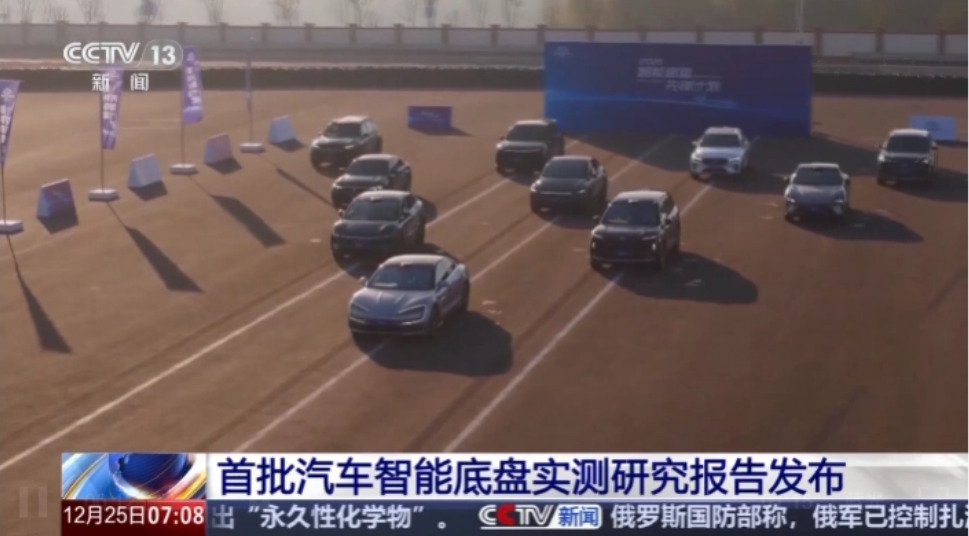
Chongqing has released the industry’s first series of research reports dedicated to intelligent measurement of automotive chassis. CCTV News reported this on December 25. In other words, the “smart” chassis topic that manufacturers like to talk about in marketing presentations has received a clearer and more formalized real-world verification.
How the evaluation was conducted: models, scenarios, and metrics
The China Academy of Automotive Engineering took on more than ten key models already on the market. For them, 13 types of test conditions were prepared, and the overall picture was compiled using more than 20 important indicators. This approach makes it possible not to limit the assessment to a single flashy test, but to look at the vehicle’s behavior comprehensively.
Examples of scenarios included in the program
- cornering with a deflated tire;
- anti-skid performance at intersections;
- hill starts (on ramps).
What intelligent chassis deliver in real driving
Yu Yinghong, a senior expert in intelligent chassis development at the China Academy of Automotive Engineering, explained that on a number of models with such systems, the electronics can “read” the body’s condition in real time during braking. It then pre-adjusts the suspension in advance, dampens excess shaking, and makes deceleration smoother and more predictable.
On open stretches of road, the logic is similar: sensors can detect changes in the road surface in advance and make adjustments before the wheels begin to slip. The goal is to prevent the vehicle from being pulled off course and to maintain its trajectory.
Which vehicles have already been mentioned as test examples
The full list of tests has not yet been disclosed, but in the academy’s official publication, three models featured in smart chassis tests were specifically named and tied to price segments:
- sedan, 500,000–700,000 yuan: BYD Yangwang U7;
- SUV, 300,000–500,000 yuan: NIO ES8;
- SUV, 200,000–300,000 yuan: Luxeed R7.
The “2025” report and new standards: what was announced on December 23
Back on December 23, Chongqing hosted a press conference summarizing tests and research conducted under the “2025 Intelligent Chassis Implementation Plan.” At the same time, the “2025 Intelligent Chassis Test and Research Results Report” was officially released, along with eight group standards for this area. In parallel, the 2026 technology testing plan was also announced, with the goal of pushing the market toward standardization and joint development.
Who participated in developing the standards
- China Automobile Research and the China Association for the Promotion of Quality and Safety of Consumer Products;
- equipment manufacturers and component suppliers;
- universities and industry experts;
- verification of solutions on real vehicles after several rounds of technical discussions.
What exactly the standards cover: 18 conditions and 4 key areas
The new set of rules includes 18 specific test conditions. The emphasis is placed on four blocks that form a unified evaluation system—from one-off checks to systematic cross-validation.
- intelligent safety;
- intelligent comfort;
- intelligent control;
- intelligent integration.
Five innovations that close “gaps” in testing
For the first time, the standard sets out five innovative items intended to close gaps in testing “smart” chassis specifically in user scenarios.
- Assessment of high-risk conditions: real dangerous situations (such as a deflated tire and maneuvers at intersections) were translated into standardized test modes to scientifically evaluate active safety.
- A new “intelligent parking” paradigm: a test solution is proposed in which, at low speeds, the combination of intelligent driving and an intelligent chassis is evaluated. It is based on expanded maneuvers, including turning in place and a “compass turn,” which is especially relevant for large vehicles and a shortage of parking spaces.
- A unified device for simulating disturbances: in the methodology for testing disturbance resistance, a device was developed to simulate yaw disturbances with clear technical requirements, in order to unify conditions and make comparison of results more rigorous and fair.
- Introduction of quantitative thresholds: in addition to an overall assessment of vehicle deviation, measurable benchmarks have been added—for example, “maximum yaw rate” and “maximum wheel correction angle,” shifting conclusions from subjective wording to precise measurements.
- Systematic cross-evaluation: the standards move away from fragmented tests of individual functions and introduce the ability to verify joint operation of systems, in order to achieve optimal synergy in safety, comfort, and handling rather than simple trade-offs (source: ithome.com).
