

China’s capital authorities have taken another step toward legalizing “conditional autopilot”: Beijing has issued Arcfox three special license plates for Level L3 autonomous-driving vehicles. Notably, just three days earlier, Deepal received a similar plate as well—though in Chongqing.
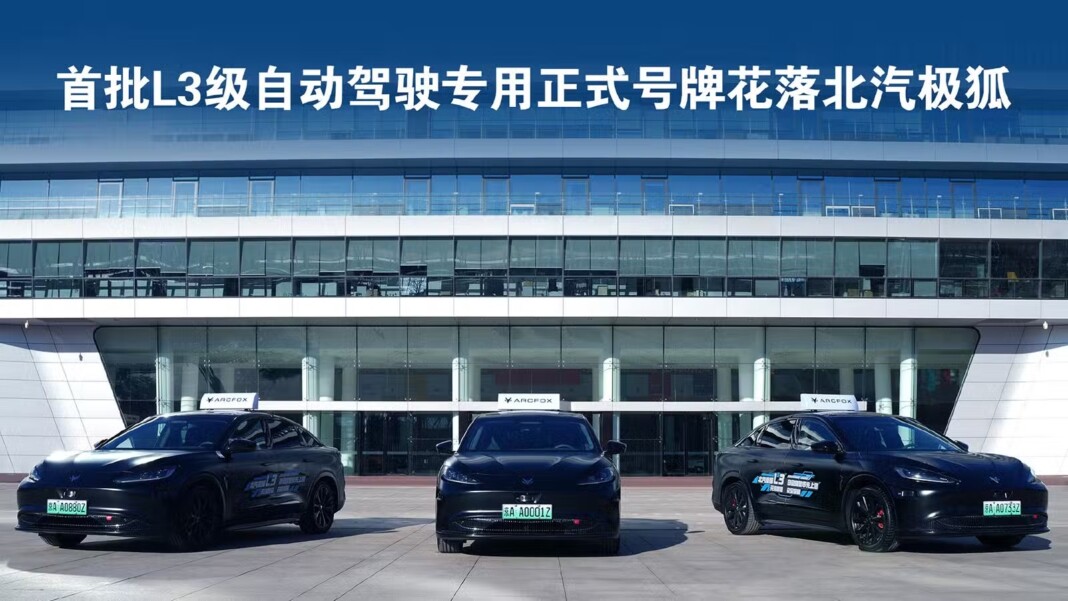
As the Beijing Municipal Public Security Bureau уточняет, three Arcfox vehicles have been officially cleared to drive on the city’s roads with plates 京AA0001Z, 京AA0733Z, and 京AA0880Z. The statement emphasizes that this symbolizes a shift from demonstration testing to a stage closer to mass application of L3 technologies, and is considered an important milestone for the “intelligentization” of the auto industry.
The model in question is an Arcfox capable of performing dynamic driving tasks under specified conditions. On certain sections of Beijing’s expressways and urban expressways, the system can operate within a single lane at speeds of up to 80 km/h. However, such driving cannot be called fully “self-sufficient”: the driver must remain in the seat and be ready to take over in an abnormal situation. At present, only three road segments in Beijing are open where this mode is permitted; on other roads, the function will be forcibly disabled.
Deepal, for its part, reported on December 20 that it had received the first L3 “rights” from Chongqing’s road authorities—with plate 渝AD0001Z. Earlier, on December 15, the MIIT approved two models with L3 automated driving: the Deepal SL03 and the Arcfox Alpha S. For the SL03, the permit applies to certain lanes on some Chongqing expressways in traffic jams, with a limit of up to 50 km/h.
According to Counterpoint, the practical benefit of the step is so far more modest than its symbolic weight, and mass production of L3 in China is expected in the first half of 2026. The next candidates for approval are said to include BYD, FAW, GAC, Nio, and SAIC; in the second half of 2026, Xpeng, Tesla, and a number of Huawei partners may join mass-produced L3 models (source: cnevpost.com).
