

On January 13, the Aito brand reported an important milestone: at the Super Factory plant in Silisi, the one-millionth mass-produced vehicle rolled off the assembly line. The anniversary car was the M9 model, which is now considered the flagship of the lineup.
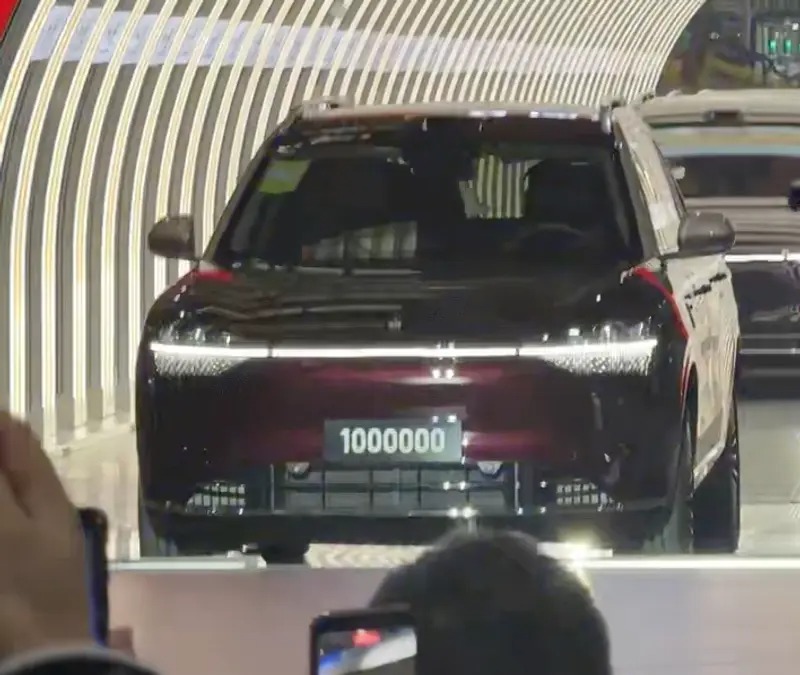
Celis Group Chairman and founder Zhang Xinghai noted that it took the company five years to produce its first million vehicles. At the same time, management has set a new, much more ambitious goal: they plan to reach the second million in just two years, which should serve as an indicator of the pace of production development.
Previously, the news already highlighted Aito’s strong results for the M9. It was reported that by the model’s second anniversary, more than 260,000 vehicles had been delivered, setting a record in the segment of cars priced at around 500,000 yuan. It is also known that on September 23, 2025, the Aito M9 will receive a new four-seat modification. It will be offered in two versions, with a stated price range from 559,800 to 589,800 yuan.
In terms of design, the four-seat M9 largely repeats the current vehicle. Up front, the Huawei intelligent projection headlights with 2-megapixel resolution and the intelligent interaction matrix optics stand out, making the model easy to recognize. The presence of four lidars is emphasized separately, as well as a new silver-purple body color.
The profile looks smooth and “premium” thanks to chrome on the window frames and side skirts. The rear is executed succinctly, yet with a sense of massiveness: under the AITO badge are full-width taillights, and chrome elements have been added at the bottom. At the same time, the rear lighting supports different lighting scenarios.
Inside, the focus is on restrained luxury. Nappa leather, suede headliner trim, a matching steering wheel, decorative elements such as a “crystal star” and a smart handle, as well as inserts made of natural white wood are mentioned.
In terms of equipment, three screens are stated: a 12.3-inch digital instrument cluster, a 15.6-inch central display, and a 16-inch screen for the front passenger. For the rear row, equipment expansion is provided via magnetic brackets behind the front seats, and multi-display interaction is implemented based on the Hongmeng cockpit. Two “zero-gravity” seats are also specified, with a maximum backrest recline of up to 150 degrees.
The powertrains are offered in two variants. The extended-range version uses a 1.5-liter engine rated at 112 kW and two electric motors at 165 and 200 kW, for a combined 365 kW and 675 N·m. The all-electric modification has a 160 kW front motor and a 230 kW rear motor, totaling 390 kW and 673 N·m. It uses a Ningde Era ternary lithium battery with a capacity of 100 kWh and an 800-volt silicon-carbide platform, which allows up to 150 km of range to be added in 5 minutes of charging (source: news.yiche.com).
